Rail geometry
Confirm 35 mm versus 15 mm rail, and whether the foot is a snap latch or a screw-down lug. A 7.5 mm rail height and a 15 mm rail height change the end-stop. Write the height you measured, in millimetres, instead of the word standard.
Buyer checklist
This checklist is a purchase-decision aid for a rail-mounted wire connector. It is not an environmental program and it is not a factory certificate. LinkScope Sourcing 41 uses it to see which specification choices are still open. An alternative housing is acceptable only after the open rows are either filled or explicitly waived by the buyer.
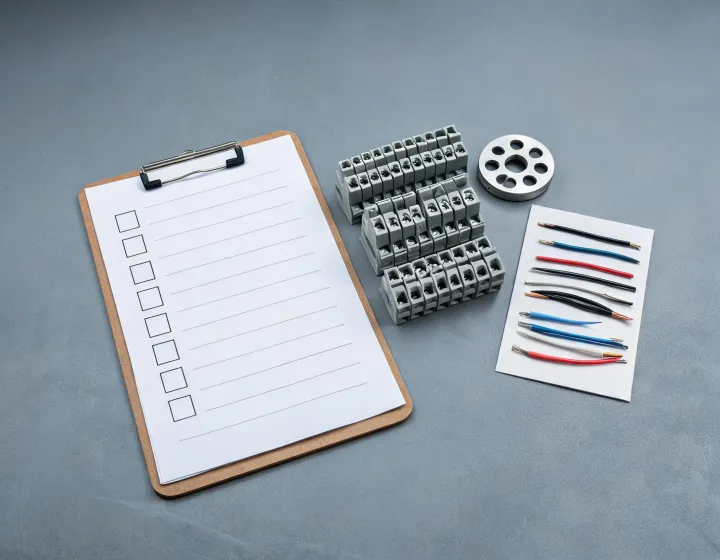
Confirm 35 mm versus 15 mm rail, and whether the foot is a snap latch or a screw-down lug. A 7.5 mm rail height and a 15 mm rail height change the end-stop. Write the height you measured, in millimetres, instead of the word standard.
Drive type, thread, and torque. If the drawing is silent, leave torque blank. Do not copy 0.5 N·m from a different pole size. A lost screw in a sample is a deviation, not a note to ignore because the plastic matched.
Cross-section, solid or stranded, ferrule or bare. A block listed for 0.5 to 4 mm2 may still reject fine-strand 4 mm2 without a ferrule. Ask the plant to mark the construction it will honor. Two conductors in one pole, if you need that, is its own yes or no.
Datasheet revision, plating callout, and the current used for any resistance limit. Calibration traceability is relevant when that resistance decides acceptance. Connector mating cycle data belongs here only for a separable connector on the same rail, not for the screw body itself.
Worked comparison, kept as a sourcing situation: a buyer held a din rail wire connector from the original drawing and a second-source block with the same 5.2 mm pitch. The process checked 2.5 mm2 stranded with ferrules, 20 A at 40 C, 500 V, and a 0.5 N·m screw. The second source matched pitch and color but printed 20 A at 20 C and omitted ferrules. The result was a recorded deviation, not an automatic swap. Prices were not treated as comparable. No saving percentage was computed.
An OEM-coded module debate is usually about switch optics and support policy. For this copper terminal, the parallel question is whether the foot, pitch, and plating follow the host drawing or a second source. The drawing-following side reduces surprise at installation. The second-source side can widen supply when 20 A, voltage, torque, and ferrule rules are checked on the exact block. A shared color does not finish either side. Accept or reject this terminal on foot, pitch, plating, and the 20 A, voltage, torque, and ferrule rules for the exact block.
New hardware may carry a clearer plating note and an unused screw. Refurbished or surplus hardware may cover a discontinued pitch when condition, remaining mechanical life, and warranty wording are verified. The desk records the condition the plant states. It does not relabel surplus as new.
Rail foot, conductor construction, current with ambient, voltage, torque, plating, accessory list, and the document revision. Impedance, insertion loss, return loss, VSWR, and frequency range are out of scope for a power terminal and in scope for a coaxial or high-speed connector if that is what the alternative actually is. Do not let a signal specification sneak into a power terminal row. Measurement accuracy of any cited electrical test stays with the plant report.
The procurement brief expands the same cells. Labels you can attach to a form live on the inquiry rows. The submission itself is on the RFQ page.
Mark which rows are mandatory, which are preferred, and which are still unknown. Ask each plant to answer the mandatory rows for one named model. LinkScope Sourcing 41 will keep deviations visible when the replies come back.
Qualified business buyers
Compare factory wholesale quotations on one wire connector specification.
FREE review of the written product, quantity, destination and sourcing requirements
Eligible orders may receive a benefit of up to 3%
Eligibility applies to qualified business buyers and is confirmed after we review your product, quantity, destination, and sourcing requirements.