Each card is a question set, not a catalog claim. The public TIA-568 overview, read on 2026-10-27 as a cabling reference, can suggest which interface to ask about. It does not certify a terminal, a splice, or a plant.
Two-conductor field splice
Record solid or stranded, AWG or mm2, and whether the pair is 2 x 0.5 mm2, 2 x 1.5 mm2, or a mixed pair. A gel-filled housing and a gland housing are different seals. Ask for the ingress protection code and the test condition, such as IP67 defined in IEC 60529 as 1 m for 30 minutes, only if the plant ties that code to the exact housing.
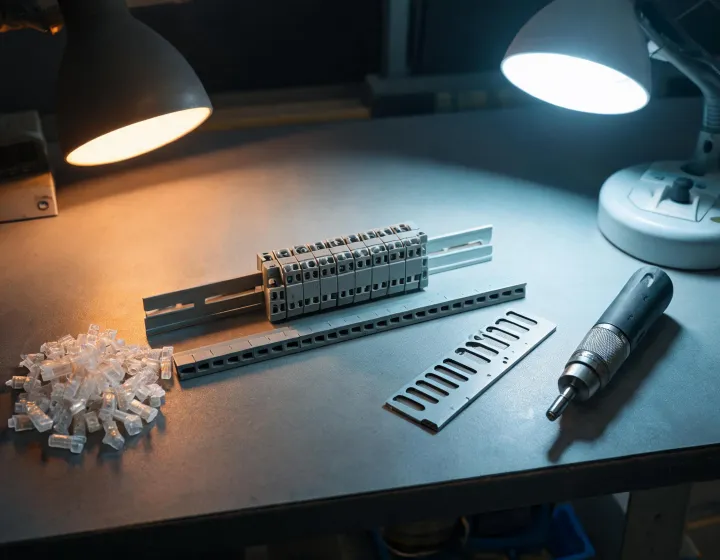
35 mm DIN rail screw clamp
Write rail height, pole count, and screw hardware. A common terminal-block class prints 800 V, 32 A, and 4 mm2, but those figures belong to a named drawing at a named ambient. Torque in N·m, often somewhere near 0.5 to 0.8 N·m, is a plant figure, not a desk default.
Lever or spring clamp
A spring clamp can take a ferrule or a stripped conductor. Ask which cross-sections are listed, for example 0.14 to 2.5 mm2, and whether two conductors may share one pole. Connector mating cycle language fits a separable plug more than a one-time splice. Do not copy a 100-cycle plug rating onto a rail terminal.
Wire-to-board tail
If the connector leaves the cable and lands on a PCB, record pitch in millimetres, contact count, and plating. Tin and 0.76 um gold answer different durability questions. Impedance, insertion loss, and return loss matter when the pair carries a high-speed signal. A passive power splice does not need a VSWR plot.